Category: Insights

  • The Essential Role of the Litigator in the AI Era

    The Essential Role of the Litigator in the AI Era

    AI is precipitating a paradigmatic shift in the architecture of complex litigation. The hype around AI, compounded by the sharp divergence in quality of AI tools and their outputs, makes the extent of the transformation difficult to perceive. But litigation is definitely changing—more than it has in decades, and the scale of change is likely to rapidly accelerate, at least for some tools and AI systems.

    The AI-driven shift is likely to upend the complex litigation process. The workflows and structures are likely to evolve, but the central role played by the litigator and the case team will not change because litigation’s essence is irreducibly human; experience required to traverse adversarial nuances with human presence and ethical bearing remains beyond the reach of any AI tool. 

    Discernment and nuance in complex litigation

    Litigation is among society’s most complex systems, encompassing interlocking procedural layers and structural frameworks that govern every stage of a case. But the complexity of litigation is now more manageable than ever through a combination of process, expertise, and sufficiently well architected AI systems. Even as this transformation occurs, attorney expertise will continue to be at the center.

    In litigation, every action and reaction can trigger a cascade of consequences. Decisions made at the pleading stage, for example, impact potential discoverability of evidence. Managing deposition witnesses while simultaneously anticipating how a judge (or later, appellate court) may read the record adds yet another layer of sophistication. At every overlapping inflection point, where a contemporaneous determination forecloses or opens future probabilities, the lawyer’s ability to reason with the case’s full trajectory in mind is integral.

    Challenges are compounded by the adversarial nature of litigation, in which the opposition seeks not only to break any previously identified patterns, but also to disrupt emerging patterns triggered by shifting data points. It is here that seasoned judgment is most decisive, with the recognition, for example, that a late-produced document may reframe the narrative or that a broader case strategy needs to be reassessed based on results of an unrelated case.   

    Complex litigation demands layered and discerning judgments by lawyers who absorb nuances and make impactful decisions based on experience that algorithms cannot replicate.

    Human presence

    Litigation experience is also essential and particularly so because of the extent to which litigation requires human presence. The litigator—not an AI tool—addresses client concerns, hopes, and fears, interacts with opposing counsel, deposes witnesses, and stands up in court. A lawyer physically embodies the litigant interests at stake and executes the narrative. After AI delivers mastery of the facts, the lawyer leverages those facts, telling the story to a human judge, jury, and counterparty.

    When tools take on the algorithmic labor of document review and other data analyses, they free litigators to immediately dive into deep case strategy and planning. Those tools allow movement away from work that is primarily computational to focus on weightier issues. How do the documents interact with each other and with the case arc? How does opposing counsel appear to be neutralizing them? What stories can the documents tell, which story will most effectively benefit the client, and how can I best tell that story?

    Whatever the answers, lawyers are mentally “there” throughout. With emotional intelligence, they exercise relational judgment and participate rather than simply observe. An emotionally attuned lawyer reads the deponent who may not be lying but is not telling the whole truth. That lawyer sees the case-changing hesitation a witness won’t voice and hears the question opposing counsel tellingly does not ask. AI’s organizing the evidentiary landscape and preparing documentary inventory, does not diminish the litigator’s role as an advocate. It enhances it, as the litigator’s full attention turns to assessing witnesses and building strategic records.

    Litigators’ perceptions are not tasks to be delegated because they are not tasks at all. Presence cannot be trained into a model; it reaches beyond processing to interpretation, serving as the foundation upon which, applied to lived experience, litigation’s essential decisions are made.

    Ethical responsibilities

    Lawyers do not make decisions in a vacuum. The profession is bound by self-regulating rules of professional responsibility. The framework demands a lawyer capable of self-regulation not only as a matter of compliance, but also as a cornerstone of professional and procedural integrity. Lawyers are expected to internalize ethical standards independently, without court supervision or adversarial oversight, even when monetary constraints and client pressures conspire to engender moral compromise.

    Beyond ethical responsibilities, each lawyer occupies a role that is, at its most fundamental level, a risk transfer mechanism. Simply put, when a client retains a lawyer, risks shift and attach to a specific person as the resulting professional relationship becomes the core unit of accountability. That accountability cannot be delegated to a tool bearing no professional obligations or consequences.

    Accountability in its most basic form requires the existence of a party with something at stake—reputational, financial, professional, or personal. A tool has no such stake. It cannot be sanctioned, disbarred, sued for malpractice, or held in contempt. It is structurally indifferent to consequences.

    Tools do not exercise moral responsibility through challenges or navigate conflicts of interest. When a client’s instructions blur ethical lines or rules of professional responsibility require disclosing evidence adverse to a client’s position, accountability is essential. A lawyer with professional obligations cannot disclaim them, and courts will not allow abdication of professional responsibility based on AI use.

    What this moment reveals

    What it means to litigate at an elite level is changing, the threshold assumptions that underlie the procedural rules are being upended, and the compositions of case teams in complex litigation are evolving swiftly. The ramifications of these advancements are likely to be far reaching. One thing that is unlikely to change, however, is the role of the (human) litigator, who will remain at the center of the litigation arena. It will be the litigator’s job to read the room, see into the eyes of the jury, hear unasked questions, and know when an algorithm’s suggestion is not right in a particular moment. AI cannot take on those roles; it can make litigators better equipped to do what they have always done.

    One way to think about litigation is as an extraordinarily complicated game. It involves cascading rulesets that vary with each matter and are themselves subject to ongoing reinterpretation. It involves distinct but interrelated mechanisms for resolving legal, factual, procedural, and evidentiary disputes. By any measure of linguistic and logical complexity, it may be the most complicated game society has devised.

  • The Central Importance of Domain-Specificity in Solving Litigation’s AI Problem

    The Central Importance of Domain-Specificity in Solving Litigation’s AI Problem

    There is a comforting temptation across law firms and legal departments toward spreading a thin, workflow-oriented layer on top of legacy technology stacks and calling that a solution for AI-powered litigation. 

    This approach, which many in the legal industry have taken in the early hype-driven innings of the ongoing AI transformation, has been shaped by the historical fragmentation of the litigation tech stack across eDiscovery, case management, and various point-solution tools. The lock-in that law firms and legal departments have had to traditional incumbents in discrete product categories, combined with the emergence of thin legal wrappers and Model Context Protocol (MCP) as an AI integration paradigm, have drawn law firms and legal departments down the path of least resistance, holding onto legacy tools and providers with long contract commitments and then crafting custom workflows in shallow AI platforms in an effort to compensate for the lack of a unified agentic system. 

    This appeal of incremental change instead of disruptive change has enabled firms to quickly access some of the lowest hanging fruit of applying AI to the litigation process. As a long-term litigation AI strategy, however, it is destined for mediocrity.

    What litigation demands of systems—to maximize the quality of litigation output, deliver significant cost reduction to clients, and to keep up pace with different litigation AI strategies over the next several years—is unlike what any other legal domain requires. That distinction has architectural consequences that workflow design alone cannot resolve.

    The complexities of modern litigation

    Litigation requires AI platforms to grapple with multiple layers of complexity. Litigation involves a vast documentary universe that can involve millions of records, spanning collections and productions, iterations of written discovery responses, and witness transcripts.

    Documents rarely carry meaning in isolation. To be fully understood, they must be interpreted through the lens of the parties’ competing legal, factual, and evidentiary contentions. Each document, admission, or piece of testimony has value only in relation to the broader logical framework of the case.

    What’s more, the meaning of documents often change as the litigation unfolds. Each production, deposition, and ruling adds context that can reframe the existing record. Legal theories evolve as claims are amended and arguments sharpened. Evidence produced early may need to be reinterpreted entirely in light of what comes later.

    Procedural rules add another layer. Litigation unfolds according to a complex, multi-level set of rules that vary by jurisdiction and judge, governing the scope of discovery, the admissibility of evidence, and how the case will be tried. Those rules can themselves change as the proceeding develops.

    The more consequential the litigation, the more acute each of these complexities becomes. The cases involving the most at stake tend to involve the vastest evidentiary records, the most procedural complexity, and the greatest degree of idiosyncrasy at every step. At that scale, the identification of significant evidence and the ability to deploy it in argument depends entirely on understanding the fluid, intricate context in which it appears.

    Where generalized AI breaks down in litigation

    The attributes that make litigation distinctive highlight certain specific limitations of generalized AI systems. Litigation is not a collection of discrete legal questions—it is a web of interconnected legal, procedural, factual, and evidentiary maneuvers. Legal theories shape which facts are relevant; facts constrain which theories are viable. A key document opens new legal questions; a shift in legal strategy reframes which documents matter.

    That web has two related but distinct properties. The first is logical interconnectedness: the structural dependency between arguments, assertions, documents, and procedure. The second is the imperative of logical command over the full context: the active, continuous capacity to navigate a living case record as it evolves, maintaining orientation and logical consistency over what matters and why1. A system that can recognize that elements are related without being able to exercise full command over the litigation context falls short of the demands of litigation.

    Foundational models are trained to generate coherent responses across a wide range of domains. However, they are not trained to hold understanding2. This is why hallucinations occur: the model fills gaps with what is statistically probable rather than what is factually accurate. The reasoning and understanding required in litigation presents a very high bar: logical command that extends correctly over a vast case record while also responding to changes in the litigation consistently and interpreting properly the evolving backdrop of controlling law, precedent, and procedural posture. 

    Complex litigation produces document populations that are, by design, internally repetitive as well: successive drafts, near-duplicate communications, overlapping productions across custodians. Within that body of work, what matters is frequently a fine-grained linguistic distinction. A word that changed between drafts. A qualification introduced in deposition testimony. A discrepancy between what was represented in correspondence and what was certified in a filing.

    What documents reveal, what they withhold, and what a single word choice might signal about intent or knowledge, these are questions that require a deep understanding of full context.

    Why putting lawyers in the loop doesn’t solve these challenges

    There is an emerging assumption in legal AI that the solution to the reasoning problem is to put attorneys in the loop: let them define the workflows, build the templates, and supply the logical structure that the AI then executes. This is definitely true for certain categories of litigation work, but it comes with significant workflow cost and also does not solve the deeper challenge of broad contextual understanding. 

    It also may be easier in theory than in practice. The people, or combinations of people, best positioned to steer workflow design may not be the ones building the workflows. Senior litigators who carry the deepest understanding of litigation logic may be far removed from AI workflow design or else may have idiosyncratic preferences that do not result in reusable patterns. What gets systematized is often not the best approach to litigation workflows or a reflection of how the best litigators actually think.

    The logical interconnectedness of litigation cannot be sustainably decentralized, at least not fully. It requires centralized architectural decisions about how that logic is represented, preserved, and made available to reasoning systems in real time.

    The litigation AI of the future

    One way to think about litigation is as an extraordinarily complicated game. It involves cascading rulesets that vary with each matter and are themselves subject to ongoing reinterpretation. It involves distinct but interrelated mechanisms for resolving legal, factual, procedural, and evidentiary disputes. By any measure of linguistic and logical complexity, it may be the most complicated game society has devised.

    In the face of such a complicated game, it seems intuitive that an AI system would need to understand the rules of that game in order to provide results comparable to those of industry professionals3. The AI system would also need a unified data environment that allows a sophisticated agentic layer to have continuous, persistent access to the full litigation context4. AI models that process language without understanding litigation’s underlying logic, or which require case teams to repeatedly construct bite-sized context from multiple data environments, will not suffice. 

    AI has proven repeatedly that it can master complex games. Chess, Go, poker, Starcraft—in each case, AI has matched and then surpassed the best human players. But mastering a game requires the right approach, and all game-playing AI that have matched or outperformed expert players have benefited from the modeling of those games in deterministic terms, including a complete articulation of the game rules, game systems, and win conditions.

    While litigation is harder to reduce to deterministic terms, the general thesis that the most successful platform for winning a game is one that understands the rules of that game, still applies. In an era of unprecedented capacity for language understanding and reasoning, an AI platform purpose-built for litigation—one that encodes its rules, understands its evolving context, and reasons across its full record—should be expected to perform at a level no generalized system can match. And when the stakes of the game are as high as they are in litigation, this performance gap matters. 

    Syllo has architected a platform that deploys agents and applies LLMs based on a deep understanding of litigation’s complexity and logic. The work product that litigation teams are producing on Syllo’s platform suggests that this approach will deliver a lawyer-AI operational paradigm that will bring a step-change in litigation quality and speed. 


    Footnotes

    1.  See Liu, N. F., et al. (2023), “Lost in the Middle: How Language Models Use Long Contexts.” Researchers found that model performance is U-shaped: while accuracy is high when information is at the very beginning or end of a prompt, it drops by as much as 20% to 30% when the relevant information is located in the middle of a long context window. https://arxiv.org/abs/2307.03172
    2. See. Dahl, M., et al. (2024), “Hallucination-Free? Assessing the Reliability of Large Language Models in the Legal Domain.” This Stanford University study found that popular models produced hallucination rates between 17% and 33% on complex legal tasks. https://dho.stanford.edu/wp-content/uploads/Legal_RAG_Hallucinations.pdf
    3. To be clear, agentic AI’s transformative capabilities have been established as to (important) subsets of litigation already. See Tai et al., Agentic AI Document Review Is Transformative for Complex Litigation (March 21, 2025), https://syllo.ai/white-paper-2025/. 
    4. For a deeper examination of the benefits of a holistic systems approach to litigation, and why neither API integration nor acquisition has been able to replicate it, read our guide on The Inevitability of the Unified Litigation Platform.
  • The Inevitability of the Unified Litigation Platform

    The Inevitability of the Unified Litigation Platform

    The tools that comprise the modern litigation tech stack were built to solve real and urgent problems. eDiscovery platforms made massive document sets searchable and reviewable. Case management tools let trial teams organize facts and build chronologies. Transcript management software made depositions navigable and linkable to exhibits.

    While powerful within their lanes, none were designed to interoperate. Naturally, each developed its own unique way of representing documents, case related information, and litigation specific workflows. Decades of acquisitions and API integrations have connected many litigation tools at the surface level without changing that underlying condition. 

    Legal AI is now being deployed into that fragmented stack. The implications of this lack of integration can already be felt as legal professionals seek to access and navigate adequate context to produce useful analyses and work products.

    Two paths to stitching together a platform, and why both fall short

    Applying AI to litigation requires managing extraordinary volumes of data, deploying specialized legal workflows, and maintaining the sustained, recursive context that this work demands. Facts surfaced in document review shape the questions asked in depositions. Deposition testimony reveals new avenues of factual investigation. Legal theories require the identification of facts that support those theories. The identification of a hot document opens up new legal questions that must be tracked down. Each aspect of litigation informs the others continuously.

    Modern tech stacks are not designed to support the interconnected nature of litigation. eDiscovery platforms are separate from case management tools, which are separate from legal research tools—not because they are disconnected aspects of the litigation workflow, but because of the technical challenges inherent to building a litigation platform that spans the full litigation lifecycle.

    Still, this continuous, recursive inference about what matters in a case (and why) is the reasoning pattern that AI is being asked to replicate. But an AI system cannot do that properly without access to adequate case context at every stage. The industry has pursued two paths to working around these constraints, but neither has produced a coherent solution.

    API integration

    The standard response to fragmentation is integration. If the tools don’t share a data model natively, build connectors. The legal tech industry is now running this playbook with AI layered on top, and the results are predictable.

    The API approach fails across several distinct dimensions:

    • Data movement: Moving data across API boundaries is slow, costly, and error-prone in practice, with teams routinely limiting what they transfer to reduce both cost and failure risk. 
    • Data representation: Each tool has its own schema and way of modeling what a document or a fact is. Reconciling those representations across systems is a perpetual source of friction and information loss. 
    • Workflow: Each tool was built with its own theory of how litigation work should flow, and an API connection does nothing to reconcile those competing logics.
    • Technical impediments for platform and dataflow scaling: Each fragmented tool approaches scaling from the standpoint of the subset of litigation workflows they are designed to address, and none has approached scaling from the standpoint of handling agents and subagents across the full litigation surface area.

    Even when data transfers succeed across these dimensions, a deeper problem remains. At the level of discrete tasks like keyword search, small-scale document batching, and basic review, API-connected systems can sometimes be workable (though often they fall short here for one reason or another). However, that approach is wholly insufficient to handle agentic workflows at scale, which often require highly specific platform configurations that are beyond the scope of traditional SaaS integrations. The handoff of AI output between different software systems transfers data but loses the context in which that data has meaning. Newer standards like Model Context Protocol (MCP) formalize this tool-calling interface but do not resolve the underlying architectural challenge. MCP is a protocol, not a platform. Persistent case understanding, multi-step reasoning across the full evidentiary record, and reconciliation of competing data models all remain problems the protocol layer itself does not solve. The seam between systems is where case intelligence leaks.

    To the extent that these stitched-together platforms operate together, the effort likely sacrifices analytic rigor and produces too shallow a factual understanding. An AI operating across data from fragmented tooling is hamstrung, lacking knowledge and unable to perform the sort of reasoning that is the hallmark of litigation practice.

    Acquisition

    If API integration is one path around the fragmentation problem, acquisition is the other. The theory is straightforward: buy the tools, integrate the teams, build the platform. The legal tech industry has been running this experiment for decades:

    • LexisNexis has made 33 acquisitions across legal technology, data, and adjacent markets. Across Time Matters, PCLaw, Juris, Concordance, and CaseMap, once the acquisition was complete, the founding team would depart within a few years. What LexisNexis inherited in each of these examples was the customer base, but not necessarily the compulsion to keep building. 
    • Thomson Reuters acquired Pangea3 in 2012 with the goal of integrating legal research with managed discovery, connecting two of the most resource-intensive phases of complex litigation under one roof. The rationale for the original acquisition never materialized into a product, and eight years later, EY acquired the business from Thomson Reuters.

    The various acquisition efforts in legal tech aimed at achieving a unified platform have failed for different reasons, but they share a common consequence. For late-stage capitalized companies, quarterly pressure, governance overhead, and the organizational weight of an acquired portfolio are some of the many reasons that lead engineering resources to flow toward whatever preserves market position, not toward building the architectural foundation that AI reasoning actually requires.

    The architecture the problem demands

    The consequence of these two paths is visible in data on AI adoption by law firms: firms with 51 or more attorneys now report generative AI adoption rates of 39%, yet a persistent barrier remains because the tools don’t share a unified picture of the case.

    A unified data model

    A unified litigation platform is built on a common data model without middleware, handoffs, or reconstruction. In this architecture, the AI layer has continuous, coherent access to the entirety of the data pertaining to the case in its current stage of litigation. 

    The platform knows the relationship of a produced document to the deposition in which it is introduced as an exhibit and knows the facts for which it has been identified as support. When the theory of the case evolves, the system’s understanding of what matters evolves with it—not because a human manually re-coded documents in a second platform, but because the data model reflects the case as a whole.

    End-to-end workflow design

    The fragmented stack is an accumulation of workflows from different vendors, each with its own architecture and theory of how litigation work should be done. The result is an amalgamated system that frequently imposes its own sequencing rather than reflecting how litigators actually think. A unified platform, by contrast, can preserve the highly-specific workflows that are critical to discovery and case management while also providing a unified design that is oriented holistically around the whole litigation while defining a new standard for exceptional human-AI interaction.

    Litigation-grade platform architecture

    There is a dimension to unified platform development that only becomes visible when you begin to deploy the capabilities of agentic systems against full litigation contexts at scale: the sheer volume of dataflow, computation, and dynamic context management involved in running agentic AI workflows requires dedicated infrastructure that is inconsistent with cross-platform integrations.

    An agentic system operating across a full case is processing and reasoning across an order of magnitude more information than any point solution is designed to handle. Legacy eDiscovery platforms were built for storage and retrieval, not for the kind of continuous, context-aware reasoning that agentic litigation AI requires. General-purpose AI assistants are not confronting this problem at all because they generally assume a narrow sliver of (manually curated) litigation context. (The full litigation context is much more than the sum of its parts.) Only a unified platform can deploy agentic tooling across a full litigation record because it is unfragmented and purpose-built to handle the diversity and scope of litigation data.

    The AI benefits of a unified platform

    Syllo was built using this unified platform philosophy from day one. That founding decision, made seven years ago, is one that neither acquisition nor API integration can replicate. This is because its value is not in any individual capability, but in the compounding effect of a cohesive architecture built consistently over time to manage the litigation record at scale.

    The scaling challenges involved in running unified agentic workflows across a complete litigation record are problems Syllo has spent seven years confronting and solving, but competitors have not yet had to face. This is also where a founder-led culture proves its value. A company still in its R&D compounding phase—where resources aren’t spent managing quarterly earnings pressure, integrating acquired teams, or maintaining a portfolio of misaligned products—is running a fundamentally different race than a late-stage capitalized competitor.

    Syllo has demonstrated the advantages of this approach through its agentic AI document review system, with the platform coordinating multiple LLMs that organize and delegate review tasks autonomously within user-defined guidelines. That architectural coherence, deployed to production in early 2024, is what produces average estimated recall of 97.8% and average estimated precision of 79.7%. More advanced agentic systems, such as those Syllo has developed over the past two years, likewise reveal the power that comes from leveraging agents broadly over the litigation’s context.

  • The Death of the 10-Step Litigation Workflow: Jeff Chivers on the “Careers & the Business of Law” Podcast

    The Death of the 10-Step Litigation Workflow: Jeff Chivers on the “Careers & the Business of Law” Podcast

    Recorded live at Legalweek 2026, Syllo CEO Jeffrey Chivers sat down with David Cowen to unpack how AI is collapsing the traditional litigation workflow. The long, fragmented path from initial discovery to a trial-ready strategy is getting shorter, and the “10-step” process many associates grew up with is becoming obsolete.

    Collapsing the workflow

    The traditional litigation model is built on distinct phases of document review, fact-finding, and legal research that often happen in sequence. Jeff explains that as litigation AI matures, these traditional linear sequences are disappearing.

    Instead of a relay race where information is handed off from one stage to the next, we are moving toward a unified intelligence model. By integrating these steps into a single workspace, the time from “first document” to “trial-ready strategy” is being reduced by orders of magnitude.

    The career-defining window for associates

    The conversation also touched on the human element: What are associates really feeling right now? There is understandable anxiety about how AI will change the “junior associate” experience. But as Jeff notes, we are currently in a career-defining window.

    • The Shift: The “grunt work” that used to define early legal careers, including manual document review and basic summarization, is being automated.
    • The Opportunity: This allows associates to move faster into high-level strategy and analysis. The associates who master these tools now are positioning themselves to lead the firms of the future.

    Listen to the full conversation

    To hear the full breakdown of how Syllo is collapsing the litigation workflow and what it means for your career, listen to the episode on the Cowen Group Podcast:

    🎧 Listen on Apple Podcasts

    🎧 Listen on Spotify

  • Syllo Webinar: Standardizing Agentic AI Across the Discovery Lifecycle

    Syllo Webinar: Standardizing Agentic AI Across the Discovery Lifecycle

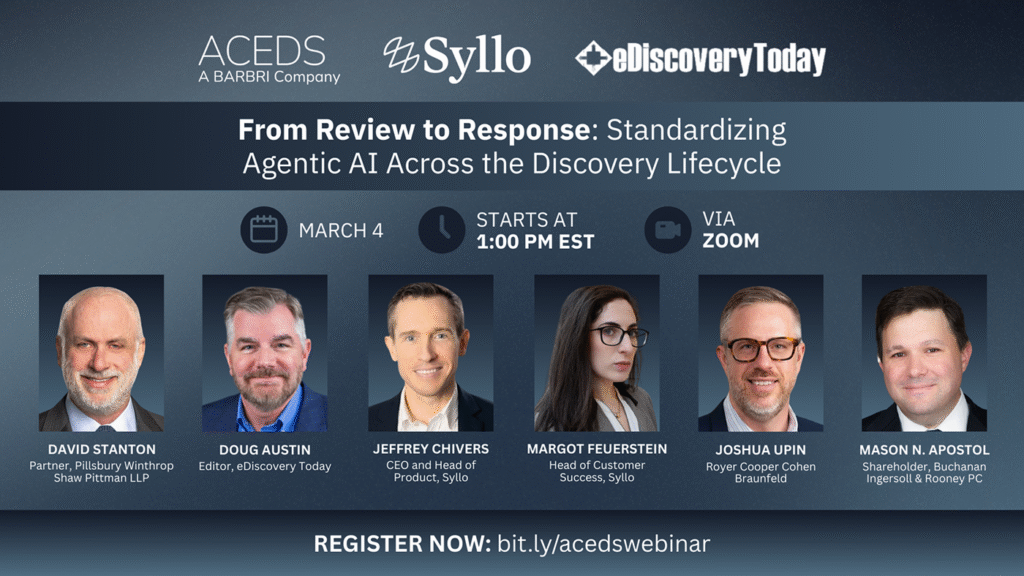
    Law firms are using agentic AI broadly across the litigation lifecycle to perform first-level document review and privilege review, prepare written discovery responses, accelerate case preparation, develop strategy, and more. Join us on Wednesday, March 4, at 1pm EST to learn exactly how, in partnership with eDiscoveryToday and the Association of Certified E-Discovery Specialists (ACEDS).


    Law firms are standardizing around agentic AI document review to handle both responsiveness review and key document identification in complex litigation. As firms have integrated this technology into their workflows, they have given increased attention to leveraging the results of automated agentic AI document review in later discovery phases, including responding to written discovery, preparing for depositions, chronology building, and proof charting.

    The discussion of practitioners and industry experts will address:

    • How to integrate agentic AI reviews
    • The quality control procedures they have implemented
    • How firms are operationalizing those results across the full discovery and litigation lifecycle. 
    • The continued impact of AI on eDiscovery and litigation generally in the coming year

    Panelists include: 

    • David Stanton, Partner, Pillsbury Winthrop Shaw Pittman LLP 
    • Mason N. Apostol, Shareholder, Buchanan Ingersoll & Rooney PC 
    • Joshua Upin, Partner, Royer Cooper Cohen Braunfeld LLC 
    • Margot Feuerstein, Head of Customer Success, Syllo 
    • Doug Austin, eDiscovery Today
    • Moderated by Jeff Chivers, CEO and Head of Product, Syllo  

    Register for the Webinar today

  • Syllo’s Alexis Mitchell on the Shift to Reasoning-Based AI

    Syllo’s Alexis Mitchell on the Shift to Reasoning-Based AI

    We are thrilled to see Syllo’s own Alexis Mitchell, Senior AI Consultant, featured in a deep-dive interview with eDiscovery Today. With over 20 years of experience in data science and linguistics, Alexis joined Syllo earlier this year to bridge the gap between complex data structures and the way attorneys actually think. 

    In her conversation with Doug Austin, Alexis highlights a critical evolution in the industry: the move from traditional Technology Assisted Review (TAR) to reasoning-based AI. 

    While traditional TAR excels at pattern matching—finding “more of the same” based on a seed set—it often leaves lawyers asking why a document is relevant. Alexis explains that modern generative and agentic AI provide what attorneys actually need: deep language understanding. Instead of simple pattern matching, these tools allow legal teams to ask specific questions and receive answers backed by logical reasoning, directly connecting technical output to legal strategy. 

    Another profound insight that the interview touches on is the inefficiency of “data-first” approaches. Alexis emphasizes that agentic AI doesn’t just process data, but coordinates work to optimize efficiency. Instead of a “data-first” approach that limits reusability, Syllo’s workflows are anchored in the lawyer’s perspective and narrative story building for a matter. 

    This evolution supports what CEO Jeff Chivers calls “intelligence-driven workflows,” where discovery isn’t just about review but integrates directly with downstream tasks like chronology building, deposition preparation, and witness kits. As Alexis notes, these connections can transform past work into reusable strategic assets and solve many of the limitations of previous eDiscovery and litigation technology solutions. 

  • Myths Busted: How Syllo’s Agentic AI Calms 5 Fears About Automated Document Review

    Myths Busted: How Syllo’s Agentic AI Calms 5 Fears About Automated Document Review

    Litigators are using agentic AI in active litigation to obtain a strategic edge.  Conducting factual investigations using agentic AI, a trial team at Quinn Emanuel was able to complete review of more than 100,000 documents, and win a bet-the-company trial in the small span of 6 weeks.  A Mayer Brown trial team used agentic AI to find 50 key documents within a universe of more than 400,000 documents that had been missed in previously conducted managed reviews.  A trial team at Ballard Spahr identified deficiencies in an opponent’s 25,000 document production within days.  Attorneys at these and other firms have found that an agentic approach to using Generative AI in document review achieves rates of recall and precision that surpass traditional review methodologies while also offering unparalleled speed, quality, flexibility, and cost-effectiveness.  

    Despite its active use in litigation and the advantages it provides, the application of GenAI to litigation is still an evolving field and the use of agentic AI is newer still.   This post clears up some misconceptions we have heard from attorneys and eDiscovery practitioners about using GenAI and Agentic AI in document review.

    Before we dive into these misconceptions, let’s explain how agentic AI is being applied to document review.  Syllo’s agentic AI document review system coordinates multiple LLMs that organize and delegate the work of the document review between one another and autonomously make decisions about how to conduct the review within guidelines set by users.  This methodology allows litigation teams to apply unlimited issue codes, dramatically increases the degree of complexity and nuance that the system can accurately handle, and reduces the cost of the reviews.  

    This post explores five commonly-held assumptions we have encountered about AI document review that do not hold water in view of Syllo’s agentic approach.

    Myth 1: AI document review is too expensive

    To the contrary, Syllo’s agentic approach to document review is far less expensive than either human review, non-GenAI implementations of TAR, or linear approaches to generative AI that run each document sequentially through a large language model.  Clients have saved 20% – 30% using Syllo’s document review solution, and sometimes more.  In addition to being less expensive on a rate basis, the superior performance of agentic AI document review means clients save by avoiding repetitively reviewing document sets that have not been correctly coded.

    The agentic approach differs from a linear approach, in which users provide an LLM with a single or multi-pronged prompt that sets forth case context and a description of what documents are responsive and/or the issues with which the document is to be coded.  In a linear approach, the LLM considers the responsiveness of each document in the review population one by one.

    The linear approach often results in higher expenses because only a limited number of issues can be included in each prompt.  If the litigation teams need to research additional issues, then a new set of prompts needs to be run over the data set.  Further, stuffing issues into a single prompt diminishes the accuracy of the results and leaves larger buckets of documents to manually sort and review on the back-end of the AI review process.  Consequently, litigation teams employing a linear prompting approach often conduct multiple trial runs over a sample set of documents in order to optimize results.  These repeated trial runs, and the limit on the number of issue codes that can be applied, add to the expense of the linear GenAI review approach.

    Myth 2: AI document review isn’t ready to match the performance of human reviewers

    It is often an unstated assumption that human reviewers are the most capable of evaluating documents for relevance and that providers of AI document review solutions must demonstrate that their technology compares favorably with human review.  In reality, initial recall rates for contract review teams typically top out at 80%.  If the issues that are the subject of review are numerous and complex, rates of recall can suffer further still.  

    The performance of Syllo’s agentic AI in live litigation, including head-to-head reviews against human reviewers, demonstrates that an agentic approach to automated document tagging performs better than human reviewers on large complex datasets.  Users of Syllo can expect to identify 95% or more of all relevant documents with a high degree of precision, and agentic reviews on Syllo have frequently yielded estimated Recall of 100% in industry-standard elusion testing.  Performance can be further improved by conducting quality control reviews and further refining instructions based on those areas in which GenAI document tagging has been overinclusive or underinclusive.

    Myth 3: We can’t risk AI hallucinations

    When language models are used to issue code documents, the outputs are the tags applied to documents.  In Syllo’s agentic review process, the tags are reviewed in connection with the actual documents in the document set.  There is no opportunity in this workflow for an LLM to invent a document.  

    Syllo’s agentic system further mitigates the risk of errors by providing transparent, explainable AI outputs that allow legal teams to understand why specific tags were applied.   Each AI tag comes with a detailed and accurate summary that explains why a tag was applied to a given document.  Moreover, the tags link to the particular excerpts of documents—so the user can be taken to the part of the document that is applicable for a given tag.   

    This built-in accountability and adaptability ensure that Syllo’s tagging enhances review accuracy while maintaining full user oversight and control.

    Myth 4: AI review will never hold up in court if challenged by our adversaries

    Courts have developed a well-articulated jurisprudence for evaluating technology-assisted review that is applicable for tagging documents with AI.  As an initial matter, producing parties are deemed to be in the best position to “evaluate the procedures, methodologies, and technologies appropriate for preserving and producing their own electronically stored information.” Hyles v. New York City, No. 10-cv-3119 (AT) (AJP), 2016 WL 4077114, at *3 (S.D.N.Y. Aug. 1, 2016) (citing Principle 6 of the Sedona Conference).  To the extent an adversary challenges the methodology, courts look to the results produced by that methodology.  As Magistrate Judge Peck wrote in the landmark opinion in Da Silva Moore, “I may be less interested in the science behind the ‘black box’ of the vendor’s software than in whether it produced responsive documents with reasonably high recall and high precision.”  Da Silva Moore v. Publicis Groupe, 287 F.R.D. 182, 183-84 (S.D.N.Y. 2012).

    The performance of agentic AI review in terms of recall and precision as compared to traditional technology-assisted review means that it is well-placed to overcome challenges.  The white paper co-authored by Syllo and 25 legal practitioners highlights how Syllo had obtained average estimated recall of 97.8% and average estimated precision of 79.7% in its ten most recent responsiveness reviews. 

    Myth 5: Our clients wouldn’t want us using unproven AI technology

    Many in-house teams are actively surveying their outside counsel about AI adoption and how law firms are integrating GenAI tools into their workflows. At a recent roundtable with in-house counsel in which Syllo participated, in-house counsel explained that they were looking for their outside counsel to take the initiative in adopting new technology for use in litigation. As AI tools become more commonly used, these expectations will only increase and a lack of adoption of such tools will only become more glaring.  The demonstrated performance of agentic AI review makes it an obvious candidate for application in complex litigation to decrease costs and identify the most critical documents in the litigation.

    The bottom line

    The legal industry has in agentic GenAI document review a transformational technology.  Many of the perceived barriers to AI adoption are rooted in outdated assumptions that do not take into account advancements that obviate objections to application of this technology.

    Syllo is proving that agentic AI produces superior results to traditional document review methodologies while resolving the challenges formerly faced in applying AI to document review.  Forward-thinking firms are already seeing the benefits—faster document review, lower costs, and a competitive edge in litigation.

    Ready to learn about how your attorneys can leverage agentic AI review in litigation? Find out more here or request a demo today.

  • Law Disrupted: Winning at Trial with AI featuring Syllo CEO, Jeff Chivers

    Law Disrupted: Winning at Trial with AI featuring Syllo CEO, Jeff Chivers

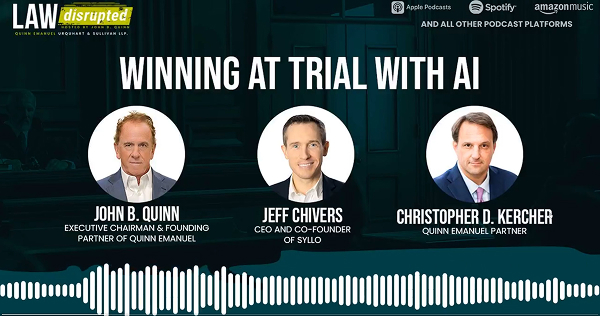
    Syllo CEO, Jeffrey Chivers, sits down with Quinn Emanuel Urquhart & Sullivan ‘s founder and Chairman, John Quinn and Christopher Kercher, partner in Quinn Emanuel’s New York office, to talk about the transformative role artificial intelligence played in a recent high stakes Quinn Emanuel trial victory in Delaware Chancery Court.

    Listen in to how Syllo’s Agentic AI Document Review helped drive a lean 4 attorney trial team through a 6 week sprint to trial, and victory. Learn how Syllo, allowed the case team to review, organize, and identify patterns across a massive volume of documents much faster than traditional methods. As well as how Syllo’s ensemble of multiple AI models and a built-in mental model of legal reasoning compliments rather than displaces the expertise of the trial team, enhancing their ability to deliver strategic insights and respond effectively to case developments.

    Click below and listen with your preferred podcast platform.

    Promotional graphic of Winning at Trial with AI, with hosts John Quinn, Jeff Chivers, Chris Kercher.
  • White Paper: Agentic AI Document Review Is Transformative for Complex Litigation

    Summary

    The increasing volume of electronic documents in litigation has made document review one of the most significant drivers of cost and delay in modern legal proceedings. Previous methods to control costs and minimize delay—including outsourced managed review and non-generative technology-assisted review (TAR)—have limitations in granularity, accuracy, adaptability, and cost efficiency. Recent advancements in large language models (LLMs) have prompted eDiscovery professionals to begin using generative AI (GenAI) in the discovery process, and eDiscovery practitioners are becoming increasingly aware that LLMs are, at a minimum, a powerful tool in document review for investigations and litigations. However, straightforward applications of LLMs to large-scale, complex document reviews have encountered challenges due to limitations such as context windows, prompt complexity, terms of art, hallucinations, multi-document reasoning, limits on the number of issue codes applied, cost and time of iterative refinement, and overall expense. These problems are heightened in complex litigations involving large datasets, which has led some in the eDiscovery industry to conclude that LLMs have only a minor or supplemental role to play in large-scale, complex document review.

    Syllo has developed an agentic AI system for document review that substantially overcomes these and other challenges. Syllo coordinates multiple LLMs that organize and delegate the work of the document review between one another and autonomously make decisions about how to conduct the review within guidelines set by users. This methodology delivers an automated document review solution that applies unlimited issue coding for large and complex document review projects in investigations and litigations. The agentic solution has consistently and substantially outperformed the benchmarks of prior generations of TAR in real-world complex litigations at a significant cost reduction compared to traditional managed review or managed review using prior generations of TAR. In the last ten completed responsiveness reviews by Syllo in live litigations, the lowest estimated Recall was 93.4%, the average estimated Recall was 97.8%, the median estimated Recall was 99.4%, and four of the reviews had estimated Recall of 100%. In the same reviews, the median estimated Precision was 85.9%, and the average estimated Precision was 79.7%.

    When guided by sophisticated practitioners who have learned to use the system, agentic document review can provide a powerful strategic advantage in complex investigations and litigations, swifter and more accurate completion of document-review projects and deposition preparation, and a significant reduction in the overall cost of discovery in document-intensive cases.


    I. Limitations of prior approaches to complex document review

    Over the last thirty years, as the use of electronic devices has proliferated, the document volumes in complex legal matters have routinely required the analysis of hundreds of thousands or millions of documents. As a result, document review has become the largest driver of cost and delay in modern litigation.[1] The litigation industry adopted two principal strategies in response to this explosion of data: outsourcing managed reviews and non-generative TAR (i.e., predictive coding) techniques. More recently, eDiscovery practitioners have begun to use generative AI to conduct linear review of documents. Each of these strategies has significant drawbacks.


    A. Disadvantages of outsourced document review

    One response by large enterprises to the increasing cost of document review was to shift large-scale document review away from trial teams at outside law firms toward consulting firms or law firm subsidiaries, often referred to as Alternative Legal Service Providers (“ALSPs”). These ALSPs manage large teams of contract reviewers to perform first-level document review and document labeling at rates below those charged by law firms. The results of the outsourced first-level review are then passed back to the litigation team for second-level review, often with extensive (and expensive) back-and-forth cycles of quality control and cleanup workflows.

    Three significant drawbacks of this outsourcing trend strike at the heart of sound litigation practices. First, outsourced review causes distributed knowledge of the factual record among numerous individuals who are not part of the trial team. Second, as the complexity and volume of the subject matter grows, the consistency and quality of the application of issue codes by review teams generally declines. Third, because it is overwhelming and time-consuming to manually review large and complex datasets for a large number of issue codes, the number of issue codes applied to datasets in managed review is generally limited. In addition, according to some studies, in complex cases, human review teams achieve average estimated Recall rates of roughly 60%, with upper-bound estimated Recall rates of roughly 80%.[2] Recall measures completeness—the percentage of truly relevant documents successfully identified by the system out of all relevant documents in the dataset.[3]


    B. Limitations of non-generative TAR (predictive coding)

    Another approach to more cost-effective document review is non-generative TAR, which relies on non-generative machine learning techniques. In its early iterations (TAR 1.0), human reviewers label a “seed set” of the document universe, which the algorithm then uses to predict the labeling for other documents. Introduced in the 2000s, these approaches to TAR advanced through the 2010s. More recently, continuous active learning (CAL or TAR 2.0) has become more widely adopted. In CAL, the model is trained continuously (or at certain breakpoints) as reviewers code documents. This workflow eliminates the need for a seed set but still requires substantial review time to achieve acceptable results.

    When properly used, TAR has provided substantial cost savings and quality improvement to the document review process. As litigants embraced these technologies, a body of case law emerged, setting forth standards for accuracy and validation. See, e.g., The Sedona Conference TAR Case Law Primer, Second Edition (2023). Courts and litigants generally formed a consensus that 80 to 85 percent estimated Recall is an acceptable and legally defensible level of performance for predictive coding models in large cases, although the specific threshold in a given case also turned heavily on case-specific factors consistent with Federal Rule of Civil Procedure 26.[4]

    Yet, non-generative TAR has significant limitations:

    Coarser Document Analysis: In general, non-generative TAR models conduct a relatively coarse analysis of documents based on word frequency, concepts, and metadata features, as compared to modern LLMs, which evaluate the contextual meaning of phrases, sentences, and longer passages with a high degree of nuance. The ability of LLMs to handle these nuances gives them a significant advantage in document analysis over prior technologies.

    Time-Consuming Startup: Non-generative TAR involves a substantial startup cost—i.e., the human time required to label documents in a seed set or label documents to enable continuous active learning. In addition, predictive-coding models have required successive rounds of training, a time-consuming process. More modern predictive coding, such as CAL, continuously trains the model using reviewer coding but still requires substantial review time to achieve acceptable results. As noted in the Sedona Conference’s recent primer on TAR case law, litigants using TAR often run many iterations of review to achieve Recall rates in the realm of 70 to 80 percent.[5]

    Limited Transparency: While non-generative TAR models generally attach a numerical score (e.g., 1-100%) to a document’s likelihood of relevance, they do not provide an explanation as to why a document was suggested as relevant with that particular score. This lack of explanation requires second-level reviewers to start from scratch when confirming whether a particular document is, in fact, responsive and why. More systemically, if the predictive coding model has incorrectly tagged a series of documents, the lack of explanation makes it difficult to understand why the documents were miscoded and how to correct this miscoding.

    Risk of Intercoder Disagreement: TAR’s reliance on human judgment may also lead to variability in how the model codes documents. Often, human reviewers will apply an issue code inconsistently, a phenomenon known as inter-coder disagreement. Human biases can also come to bear, leading to fundamental shifts in relevance assessments as the review proceeds. If a predictive coding model learns from such inconsistently coded documents, it too runs the risk of applying codes inconsistently or becoming confused by the mixed messages sent by disparate reviewers.

    Limited Issue Codes and Adaptability: The need to train non-generative TAR models with human labeling makes it pragmatically difficult to apply a large number of issue codes to a complex dataset. Human review speed generally slows down as the number of issue codes increases, which places a practical constraint on the number of issue codes that can be applied with non-generative TAR. Similarly, the amount of time required to train and test predictive coding models is also a major drawback when new issues arise in the midst of the investigation or litigation. These limitations can restrict the usefulness of predictive coding models in more complex cases where the investigation objectives of the case team involve nuanced matrices of relevant facts, participants, categories, and timelines, which can evolve as new facts are uncovered as the discovery process unfolds.


    C. Shortcomings of linear GenAI document review

    As LLMs have evolved, the legal industry has explored whether these models could improve upon the TAR predictive coding algorithms. Since modern LLMs are pre-trained on vast corpuses of data and can perform accurate document classification based on natural language instructions (i.e., “prompts”), they require little to no training on case-specific documents or labeling by subject matter experts. The linguistic and conceptual nuance that is embodied in modern LLMs enables them to make distinctions and perform relevance predictions that significantly exceed TAR methodologies.

    However, many of the efforts to utilize LLMs still involve a linear approach to reviewing and coding documents. For example, users provide an LLM with a single or multi-pronged prompt that sets forth case context and a description of what documents are responsive and/or the issues with which the document is to be coded. The LLM then considers the responsiveness of each document in the review population one by one.[6]

    This kind of linear GenAI review, while potentially adequate for smaller datasets (hundreds to thousands of documents), encounters significant limitations when applied to more complex and document-intensive matters:

    Prompt Overload: A core challenge of linear LLM deployment in large-scale document reviews is the difficulty in creating a single, comprehensive prompt that accurately captures all relevant, nuanced factual issues, given the initial uncertainty inherent in complex cases. Splitting a complex prompt into multiple prompts (such as one prompt per issue code) can multiply the cost of review when each prompt is run linearly over the dataset. Further, the more complex and data-intensive the case is, the less certainty the prompt drafter has about the nuanced factual issues that may be hiding in that dataset, and the more complexity that needs to be packed into a prompt run linearly across the dataset. Attempting to address a multitude of issues in an aggregate prompt (such as a prompt comprising ten issue codes) increases the risk of overloading the LLM, diminishing its accuracy as it struggles to process all instructions simultaneously and creating a risk of inaccurate or incomplete coding. Improperly applied coding may require extensive quality control to detect, and necessitates additional, costly GenAI passes over the dataset to achieve a more accurate result. A complex, multi-faceted prompt requires more computational resources to review each document, resulting in a more expensive process overall.

    Limited Issue Codes and High Cost for Large Datasets: The risks of prompt overload and cost overruns have caused some providers of GenAI document review software to place a limit on the number of issue codes or prompt length. However, when these limits are applied, a different problem arises. It is common in complex litigation for a party to be served with 20, 30, or more document requests, and when designing their own investigations, case teams often want to investigate dozens of issues or narrative threads. Document review approaches that are limited either technically or practically to a smaller number of issues thus do not meet the real demands of complex matters. Rather, they impose a constraint into which lawyers must artificially conform their investigation strategy to the limitations of linear GenAI review. This can lead users of linear GenAI review solutions to make compromises on the granularity of their review protocol. When more general issue codes are applied, human review teams must spend additional time sifting through these broad categories of documents to find relevant documents at the back end of the GenAI workflow. Broader issue codes could also require a re-run of an entire review or running multiple review passes to get closer to the more nuanced, desired results, which can rapidly increase the cost of the GenAI effort to the point of being cost-prohibitive.

    Lack of Cost-Effective Adaptability: The reality of complex litigation is that strategic priorities and the perceived importance of given factual strains constantly shift and evolve as the case progresses. Linear GenAI does not readily adapt to this dynamism. A linear GenAI review process that requires subsequent “passes” across the dataset whenever a new issue arises is often cost-prohibitive as latency increases to intolerable rates. This fundamental disconnect from the innate dynamism of investigations and litigations significantly limits the effectiveness of linear GenAI approaches in complex cases.


    II. Syllo’s agentic AI document review: a new paradigm

    Syllo has created a novel, agentic AI system for document review that leverages an ensemble of varying-sized LLMs to conduct large-scale document analysis in complex investigations and litigations. Instead of a single-pass approach, Syllo orchestrates multiple LLMs performing distinct roles, including, among others, the roles of strategizing, determining next steps, performing quality control, extracting learnings from documents, synthesizing knowledge from learnings across documents, summarizing, and resolving inter-model disagreement. The behavior of the overall system and the dataflows involved in performing the document analysis are influenced by the outputs of the various LLMs working in concert.

    The design and empirical studies of Syllo’s agentic approach indicate a higher ceiling on granularity, adaptability, context-sensitivity, cost-efficiency, and complexity as compared to prior non-GenAI and GenAI methodologies for large-scale document reviews.

    The upshot for litigation teams is a document analysis system that can perform a highly accurate and categorized review to assist them at every stage of document analysis in litigation, including dataset culling, responsiveness review, subject matter issue coding, privilege review, and identification of hot documents. The benefits of this approach are numerous:

    Dynamic Resource Allocation for Cost Efficiency and Accuracy: As the agentic review progresses, the telemetry of the system allows for observation of the amount of work performed by each LLM in each role. More complex and conceptually challenging datasets and documents will trigger more work performed by higher-end LLMs, whereas more straightforward review challenges will lean more heavily on the most cost-effective LLMs. This approach results in more efficient and less costly LLM application to complex document review and permits the ensemble of LLMs more freedom to determine which documents and parts of documents deserve a closer look for particular issues or nuances. It allows selective activation of more powerful or specialized models as needed to improve the quality of the review and minimizes reviewing completely irrelevant documents. This “division of labor” between LLMs mirrors the complexity of the document review project, akin to how complex reviews performed with outsourced reviewers resources might require more quality-control time and subsequent cleanup review hours.

    Unlimited Issue Coding: Very significantly, an agentic approach cost-effectively accommodates an unlimited number of issue codes without causing prompt overload and without altering the system’s accuracy. This allows the granularity of the document analysis to match the number of requests for production or issues defined by the case team. As shown below, case teams routinely use Syllo to apply dozens of issue codes across large datasets. Also, for each label applied for each issue, the system provides a concise explanation of why a particular document (or its parts) is responsive to that issue with navigation to the relevant document content.

    Swift and Cost-Effective Adaptability: Syllo’s agentic document review process does not require a seed set and does not require training a model each time the case team wants to add issue codes or change coding parameters. In fact, new legal issues can be integrated seamlessly, allowing on-the-fly adjustments without reprocessing the entire data set, simply by creating another natural language description of the issue to be investigated. The agentic system can leverage prior document analysis to accelerate and reduce the cost of these subsequent targeted queries. The result is a flexible and agile system that can adapt as the legal theories, facts, or other variables change in a matter. In addition, the work product created by the ensemble of models can be leveraged in subsequent analyses over the same dataset, and coding refinement (where the case team realizes an issue code was overly broad or unduly narrow) can be performed surgically at a small fraction of the cost of re-running an entire review.


    III. Empirical validation

    Syllo’s AI systems have been used on active matters since 2023. In cooperation with law firm partners, the Syllo team has successfully completed more than 80 agentic document reviews in active litigation, with datasets spanning from thousands of documents to more than 2 million documents. Syllo has been used to apply dozens of issue codes in hours or days across hundreds of thousands of documents. These reviews have spanned numerous subject matters, including antitrust litigation, environmental litigation, contract litigation, employment litigation, patent litigation, bankruptcy litigation, mass tort litigation, construction litigation, investment and shareholder disputes, M&A litigation, automotive litigation, real estate litigation, and insurance coverage litigation. Along the way, the Syllo team has developed standard workflows to leverage the capabilities of the agentic system. In the last ten completed responsiveness reviews by Syllo in active litigations, the lowest estimated Recall was 93.4%, the average estimated Recall was 97.8%, and four of the reviews had an estimated Recall of 100%. In the same reviews, the median estimated Precision was 85.9%, and the average estimated Precision was 79.7%.


    A. Syllo in responsiveness reviews

    1. Commercial litigation

    Ballard Spahr LLP (“Ballard”) represented an enterprise in a commercial litigation in which the Ballard client was interested in reducing the cost of its document review burden. Ballard attorneys educated the client on the option to use Syllo for the responsiveness review, and the client elected to move forward with Syllo as the solution for the responsiveness review.

    Ballard’s client needed to respond to more than 30 requests for production served by the opposing party, and the collected dataset was more than 100,000 documents. With guidance from the Syllo team, the Ballard trial team articulated more than 25 issue codes that corresponded to the requests for production. It took approximately three hours of human time to set up the instructions for the review. No iteration was performed on the prompts based on human review of documents. Syllo’s agentic system applied more than 25 codes to the documents. More than 50,000 documents were identified by Syllo as responsive to one or more issues. The Ballard trial team performed precision testing and elusion testing and determined an estimated Precision of 95.56% and an estimated Recall of 99.4%.

    Based on the performance of agentic review for responsiveness, the Ballard team also deployed agentic review on the opposing party’s production of more than 25,000 documents to identify deficiencies in the production. Syllo identified numerous specific gaps in the opposing party’s production, which enabled Ballard attorneys to demand a remedial production in a matter of days. The trial team also used Syllo to exclude non-responsive documents from the potential privilege documents and to make preliminary privilege calls to facilitate trial team review.

    The Ballard team obtained a favorable resolution of the litigation for their client.

    “We were able to complete a large document production with a high degree of confidence that we had identified all of the responsive documents,” said Casey Watkins, Of Counsel at Ballard. “Setting up the review was straightforward, and the review took a fraction of the time it would have taken if conducted using human review teams. Given the results we achieved and the amount the client paid for the total review, we were able to provide enormous value to our client.”

    Ballard has subsequently employed Syllo in other document-intensive litigations, including for the application of more than 25 issue tags across a dataset of more than 1.5 million documents in a highly complex commercial litigation, which is currently the most complex litigation in which Syllo’s agentic review has been deployed.


    2. Commercial litigation

    Joshua Upin, Esq., of Royer Cooper Cohen Braunfeld LLP (“RCCB”), was interested in performing a head-to-head comparison of Syllo’s agentic review capabilities against a managed review team leveraging CAL in an ongoing matter. The case selected was a complicated commercial litigation, involving hundreds of entities, many categories of commercial transactions, and more than 25 requests for production.

    For the head-to-head comparison, both the managed review team and Syllo received the same review set of slightly less than 16,000 documents. This review set was randomly selected from the broader document population of more than 150,000 documents. The reviewers and the AI system performed their work using separate document coding platforms.

    The complexity of the document review created challenges for the review team to accurately tag the documents. The review team required additional guidance and training from the trial team during the review, and based on second-level and quality-control reviews, there were multiple rounds of correction and re-tagging of the first-level review coding. Ultimately, the additional time and remedial work required for the outsourced review team to conduct their review of roughly 16,000 documents resulted in a per document review cost exceeding $2.00 per document.

    When the coding results were compared head-to-head, Syllo’s performance surpassed the human reviewers by a significant margin. The review team marked more than 5,400 documents in the head-to-head sample as responsive. Elusion testing against the review team revealed an estimated Recall rate below 67% and widespread miscoding that triggered several rounds of re-review. Syllo performed its review without any prompt refinement based on reviewing documents or overturns by the review team, and the RCCB team’s validation of Syllo’s coding revealed an estimated Recall of 93.44% and an estimated Precision of 69.81%.

    “Our adoption of Syllo’s review solution has significantly reduced the time it takes for us to review our own documents and identify important documents in opposing parties’ production and provided better results than any other alternatives,” said Josh Upin, partner at RCCB. “In view of Syllo’s superior performance to human review and other available review platforms, it’s now my practice to use Syllo on document reviews of any significant size rather than hiring outsourced review teams. Learning and leveraging this technology enables me to get more quickly to documents that matter and better serve our clients while saving them significant expense.”


    3. Commercial litigation

    A trial team at Quinn Emanuel Urquhart & Sullivan, LLP (“Quinn Emanuel”) was engaged as counsel in an accelerated litigation less than two months before trial was scheduled to occur. In the span of six weeks, the team needed to complete responsiveness reviews of more than 30,000 documents, review more than 40,000 documents produced by opposing parties, and complete depositions and pre-trial submissions.

    For the responsiveness review, the Quinn Emanuel team initially defined more than 20 issue codes and prepared GenAI review instructions to use Syllo to perform the first-level document review. In a set of more than 30,000 documents, elusion testing confirmed that the estimated Recall was above 98% and the estimated Precision was above 74%. With respect to the review of opposing party productions, the trial team defined more than 40 issues for investigation and used Syllo agentic review to perform first-level review on a rolling basis. Finely categorizing the documents into 40 different categories allowed the team to find critical documents expeditiously, streamlining deposition and trial preparation. As the team identified new avenues of investigation, they defined new sets of review instructions, ran the instructions against the documents produced in the case, and were able to complete follow-up investigations within hours of identifying new issues.

    Production in the litigation occurred on a rolling basis. Syllo’s ability to store previously defined issue codes and apply them to new productions and collections enabled the trial team to complete first-level reviews of new document sets within hours of their receipt. The trial team also used agentic review to identify deficiencies in the opposing party’s production. Given the timeframe of the litigation, this ability to rapidly identify gaps in productions and request supplementation ensured that the team had the evidence they needed to go to trial.

    “Facing a high-stakes commercial dispute with only eight weeks until trial, our team needed to accomplish what seemed impossible—complete a substantial document review and production from our client, review opposing counsel’s documents to learn the case, and prepare for depositions on an extremely compressed timeline,” said Chris Kercher, a partner at Quinn Emanuel. “Syllo transformed our capabilities overnight. We rapidly identified and produced responsive materials from tens of thousands of documents to meet court-ordered deadlines, while simultaneously gaining unprecedented command over the adversary’s production. What truly differentiated Syllo was its ability to help us instantly adapt our review strategy as new issues emerged in the opponent’s documents, identify critical gaps in their production, and secure vital supplemental productions before deposition deadlines. In fast-moving, complex litigation where strategic advantage is measured in days, not months, Syllo transformed what would have been a logistics challenge into our strategic advantage.”


    4. Employment litigation

    The plaintiffs’ employment firm Outten & Golden LLP has used Syllo to assist with many forms of document review and analysis. As one example, attorneys with Outten & Golden used Syllo to identify documents for production in a collection of 12,543 documents. The Outten & Golden team based their instructions to Syllo closely on the requests for production that had been served on their client in the case, resulting in the definition of 28 issue tags. One issue code was detected as overbroad as the system began its review, and that one issue code was re-drafted. Syllo applied the 28 issue tags across the documents and tagged 484 documents as responsive to one or more requests for production. An associate attorney with Outten & Golden conducted a second-level review of the documents tagged responsive and determined a Precision rate of 84.09%. The associate also performed elusion testing on the documents deemed non-responsive and found no documents in the null-set sample that were responsive, yielding an estimated Recall of 100%.

    Based on numerous validations of Syllo’s document review solution, Outten & Golden uses Syllo’s agentic document review to review large client collections and certain document productions. The firm has observed results that exceed the standards for human and traditional TAR review.

    “We’ve used Syllo’s automated document review function, and we were really impressed with the results,” said Melissa Lardo Stewart, Partner at Outten & Golden. “Syllo completed a review of thousands of documents in a few hours and our team’s review determined that it identified and labeled responsive documents accurately.”


    B. Finding hot documents

    In addition to reviewing documents for production, Syllo has been used to review the production record to identify hot documents for depositions, pre-trial motions, and trial. In these instances, the agentic reviews are conducted solely for the case team’s analysis. Case teams use Syllo’s agentic review system to identify decisive key documents from among vast swaths of responsive documents for a given issue.


    1. Commercial litigation

    A trial team at Quinn Emanuel was engaged in a fast-paced litigation in advance of a preliminary injunction hearing in a commercial dispute. The team had less than a month to complete document productions and depositions. The trial team decided to use Syllo midway through its deposition preparation, as both a cross-check to make sure that key documents had been identified and to broaden their search to cover new, fast-arising issues more comprehensively than through keyword searching.

    The team used Syllo to review more than 40,000 documents and to identify all documents that hit on more than 30 different issues. The trial team used Syllo for a zero-shot review (i.e., the Syllo review ran once without the benefit of any prompt refinement based on document tagging performance). The Quinn Emanuel trial team performed precision testing and elusion testing on the zero-shot review, which confirmed that Syllo identified responsive documents with an estimated Recall of 98.69% and an estimated Precision of 92.83%. As to the issues that the Quinn Emanuel team had already reviewed, Syllo’s review confirmed the effectiveness of the trial team’s search of the document population. For the new issues, Syllo’s review identified more than 200 key documents that had not previously been identified.

    “Syllo enables the streamlining of issues and organization of documents for complex litigation, allowing trial teams to move faster and more easily control the factual history of the case,” noted senior associate Paul Henderson. “Syllo’s agentic system reliably surfaces documents responsive to key issues and navigates substantial factual complexity better than any AI tool I have seen.”


    2. Commercial litigation

    A trial team at Quinn Emanuel was faced with a tight timeline to prepare for depositions in a complex commercial litigation relating to the private equity industry. The team had already overseen an extended managed document review process and then the court allowed the opposing party to amend its pleadings months before the close of discovery. As a result, there were several new key issues that had not been the focus of a prior review.

    The production universe in the case was more than 2 million documents. Syllo was first used to perform a targeted review to return a universe of the top 150 documents related to the new issues raised in the amended pleadings. The documents identified by Syllo were described by the trial team as “incredible.”

    With depositions scheduled over the next four weeks, the Quinn Emanuel trial team next relied on Syllo to analyze the full production universe, including document productions that were produced after the review was complete, to provide a small number of “hot” documents responsive to 40 issue codes. Syllo’s agentic review system churned through the production universe to identify and narrowly return only the few hottest documents that related to any of more than 40 key factual propositions the trial team had identified in the leadup to depositions. Syllo identified, across six witnesses, 750 unique hot documents, 120 of which were newly identified in the case.

    “The litigation situation we found ourselves in was familiar to many litigators—we had budgeted a certain amount for document review, and then the court’s decision changed the focus of the case,” said Melissa Dalziel (Of Counsel at Quinn Emanuel at the time and now Counsel at Alston & Bird). “Syllo allowed us to completely recalibrate our strategy and find a manageable number of the most relevant documents within a vast data set.”


    3. Commercial litigation

    A trial team at Mayer Brown LLP was more than two years into a high-value litigation. The litigation involved nuanced issues of contracting and construction. More than $300,000 had already been spent on managed document review in the litigation, and reviewers had already reviewed the production universe of more than 400,000 documents spanning more than 8 million pages.

    Given the complexity of the document review and the stakes of the litigation, the Mayer Brown team wanted to ensure that key documents had not been overlooked as they prepared to enter a period of depositions. The Mayer Brown team articulated 15 primary issues to be addressed in depositions and trial, and they worked with the Syllo team to conform those issues into 15 issue codes for an automated first-level document review. Syllo completed the review, applying 15 issue codes across more than 400,000 documents in less than one week. Syllo’s agentic system identified slightly more than 18,000 documents as highly relevant to one or more of the issue codes and escalated a subset of hot documents for each of the issues.

    Upon reviewing the hot documents identified by Syllo, the Mayer Brown team immediately identified critical documents that Syllo had escalated and that had not been previously identified in prior reviews. Ultimately, more than 50 documents that were not escalated by the managed review team but that were identified as highly relevant by Syllo were selected as hot documents by the trial team and slated for use in deposition, which represented almost 20% of the overall hot documents selected.

    The Mayer Brown team concluded that having Syllo’s agentic review system perform a cross-check review in such a high-value litigation was more than worth the expense. “In high-stakes litigation, the prevailing party is often the one that is able to introduce the most compelling evidence to support their case,” said Brandon Renken, partner at Mayer Brown.

    “Apart from its speed and cost-effectiveness, Syllo more than proved its value by finding key documents that had been missed in the previously conducted managed review.”


    C. Additional applications in litigation

    Law firms have also successfully used Syllo’s agentic document review solution in other creative ways, such as complying with requirements to label production datasets by document request and to perform quality control analysis on human-reviewed datasets.


    1. Labeling every document by request for production or interrogatory

    In a commercial litigation, Nixon Peabody LLP used Syllo to help satisfy a challenging directive from a tribunal to identify the request for production or interrogatory to which each of the 9,000 produced documents pertained. There were more than 30 requests and interrogatories, which translated into applying a coding palette of 30 issue codes. Prior to selecting Syllo for the project, Nixon Peabody began the review project with attorney and paralegal review staff, but due to the number of issue codes, the rate of review was not fast enough to meet the deadline. Nixon Peabody opted to use Syllo. At the time Syllo conducted the review, Nixon Peabody had just a few weeks to comply with the directive.

    The document set was unique in that nearly every document was responsive (a richness of 100%). The Nixon Peabody trial team conducted a sample-based second-level review of the tagged documents to ensure that the tagging was correctly applied. Syllo expedited the process of review by providing rationales for the application of each tag. Nixon Peabody’s head of eDiscovery and litigation support, Mike Swiatocha, noted that providing the rationales for the tagging of each document inverts how documents are analyzed in the document review process, allowing second-level reviewers to focus on what is important in the case rather than labeling or summarizing documents. This allows for expedited review of the documents on a second-level review.

    Not only was Nixon Peabody able to complete the second-level review in only a few days, but the trial team concluded that Syllo’s review had been highly accurate.

    “Any attorney would have really struggled to complete the project for which we used Syllo, especially given the time pressures involved,” said Mike Swiatocha. “Syllo was the perfect solution because it could apply a superhuman number of issue codes to each document and apply them with impressive consistency.”


    2. Early case assessment

    A trial team at Quinn Emanuel was engaged in a bankruptcy proceeding and needed to perform early case assessment on multiple sets of document productions, totaling more than 20,000 documents, so they could advise their client on the case posture and represent them at the proceeding. The review needed to be conducted on an expedited basis in advance of a hearing that was scheduled for a week after the team began ingesting documents onto the Syllo platform.

    The Quinn Emanuel team deployed Syllo’s agentic system in two ways. First, they ran Syllo’s agentic document review over each population of documents as they were produced (more than 15 productions) from several parties to the bankruptcy proceeding. These reviews helped organize the documentary record around the key topics in the case, allowing fine-grained control over the documentary universe and helping the trial team quickly spot key issues that advanced their client’s interests, which was essential given the tight case deadlines.

    Second, they identified more than 25 key facts that were central to their theory of the case and used Syllo’s agentic system to identify the 10 most relevant documents for each fact. This allowed the Quinn Emanuel team to quickly compile key documents for multiple depositions scheduled within days of receiving documents in rolling productions from multiple parties ahead of the hearing.

    “Syllo is a groundbreaking platform that has quickly become my favorite document review tool,” said associate Joanna Caytas. “I was skeptical at the beginning, but Syllo delivered in a cost-efficient way what would have been very difficult to accomplish for a lean team on this timeline.”


    3. Cross-checking reviewers when responding to interrogatories

    Pillsbury Winthrop Shaw Pittman LLP (“Pillsbury”) utilized Syllo in a complex litigation to help analyze and identify documents responsive to contention interrogatories from a universe of more than 78,000 documents. This task was particularly challenging because the human review team had already used a set of 15 highly nuanced issue codes to categorize documents responsive to these interrogatories. Due to aggressive case deadlines that made it difficult to validate the review results in the time remaining, Pillsbury used Syllo to supplement the review team’s efforts in order to ensure completeness and accuracy.

    Not only did Syllo validate the human review, but it also identified additional important documents that had been missed by human reviewers and highlighted certain documents the reviewers had coded inconsistently or incorrectly. Hence, the Syllo workflow provided an effective quality control mechanism that helped the team identify additional interrogatories to which a document might be responsive. In several instances, even though a human reviewer may have tagged a document as responsive to a single interrogatory issue, Syllo was able to identify additional issues relevant to that document. Importantly, these suggestions included an attribution that simplified validation by pointing out the specific pages or sections of each document that made it responsive to the issue code. Among the examples:

    • One issue required fine-grained analysis and likely had few responsive documents. This was selected for a deep-dive evaluation. Reviewers coded 49 items responsive to the issue, and, of these, Syllo coded only seven responsive. The Pillsbury team reviewed the other 42 documents and determined that none of them were responsive to the issue.
    • Syllo coded 10 documents as highly responsive to another issue, of which the human reviewers coded just one document as responsive. The Pillsbury team reviewed the ten documents and determined that all of them were probative of the issue.
    • Syllo coded 73 documents as likely responsive to another issue, of which human reviewers had coded only six responsive. The Pillsbury team checked the other 67 documents and found most of them were, in fact, responsive to the issue.
    • For another issue code, the reviewers coded 22 documents as responsive, but Syllo coded only 11 responsive. Pillsbury reviewed the 11 human-coded documents and determined that none of them were responsive to the issue in question.
    • Syllo correctly identified 454 documents as very responsive to issues that had not been flagged by the review team (although they had been found responsive to other closely connected issues in the case), thereby demonstrating the platform’s ability to parse nuanced distinctions between related topics.

    As a result, the Pillsbury team developed sufficient confidence in the system to begin to deploy it in more standard review workflows.

    “Syllo’s automated document review is reliable and provides unrivaled transparency into specific document characterization,” said David Stanton, a partner at Pillsbury. “Far from being a ‘black box,’ the tagging rationales applied by Syllo let us see why particular tags were applied to specific documents. This enabled workflows to adjust, optimize, and confirm the instructions we provided, and allowed us to very quickly leverage the insights we gained from its use.”


    VI. Conclusion

    Syllo’s implementation of agentic document review has consistently and substantially outperformed the benchmarks of prior generations of TAR in real-world complex litigations at a significant cost reduction compared to traditional solutions. Syllo’s implementation of agentic document review indicates superior granularity, adaptability, context-sensitivity, and complexity handling as compared to non-GenAI methodologies and linear GenAI methodologies. Case teams leverage Syllo’s superior performance for responsiveness reviews at every stage of document analysis in litigation, including responsiveness review, subject matter issue coding, privilege review, and identification of hot documents. When guided by sophisticated litigators, agentic document review provides a powerful strategic advantage in complex investigations and litigations.


    Footnotes:

    1. Dr. Callan serves as a research advisor to Syllo.
    2. The Practitioner Contributors have contributed to this paper in their individual capacities.
    3. Mr. Elkhoury’s contributions occurred while he was an attorney associated with Mayer Brown, but he has since founded the law firm of Elkhoury Law PLLC.
    4. Mr. Stromberg serves as a product advisor to Syllo.
    5. Ms. Dalziel’s contributions occurred while she was an attorney associated with Quinn Emanuel, though she has since taken a position with another firm.
    6. John H. Beisner, The Need for Effective Reform of the U.S. Civil Discovery Process, 60 Duke L.J. 547 (2010).
    7. Maura R. Grossman & Gordon V. Cormack, Technology-Assisted Review in E-Discovery Can Be More Effective and More Efficient Than Exhaustive Manual Review, XVII RICH. J.L. & TECH. 11 at 37 (2011); Maura R. Grossman & Gordon V. Cormack, Technology Assisted Review in Electronic Discovery in Data Analysis in Law (Edward J. Waters ed. 2018). The contributors do not mean to disparage managed review teams. Reviewing large volumes of documents in complex litigation is simply an extremely hard thing for any group of people to do without the assistance of technology.
    8. Practitioners also measure Precision—the percentage of documents identified by the system that are actually relevant.
    9. Bolch Judicial Inst., Technology Assisted Review (TAR) Guidelines, January 2019; see also The Sedona Conference TAR Case Law Primer, Second Edition (2023).
    10. See, e.g., ibid.
    11. See, e.g., Relativity & Redgrave Data, Beyond the Bar: Generative AI as a Transformative Component of Legal Document Review (2024).

  • Is there Underwriting Judgment To Be Had in AI?

    Is there Underwriting Judgment To Be Had in AI?

    At the recent PLUS D&O Symposium, Syllo CEO and Co-founder, Jeff Chivers, participated in a discussion on Generative AI’s impact on underwriting, the insurance industry, and addresses the question of whether AI can replace human judgment. This in-person dialogue provided a platform for Jeff to share a perspective that is core to our mission at Syllo. 

    Can AI replace human judgment in the next 5 years? Jeff notes, “I think it is the biggest question out there.” He goes on to frame the conversation not as a matter of replacement, but as one of partnership. This viewpoint is the foundation of our work at Syllo. Our AI-powered litigation workspace is designed to augment the capabilities of legal professionals, handling procedural tasks so they can focus their expertise on the complex and strategic elements of a case—areas where human judgment is irreplaceable. 

    Jeff goes on to offer views on the inherent limitations of large language models when left to their own devices. He emphasized that while many Generative AI tools are powerful for some tasks, they are unable to replace certain human cognitive roles. As he explains, “While these models are remarkable at pattern recognition, they fundamentally lack the ability for nuanced reasoning and moral judgment.” This perspective frames the conversation around the irreplaceable value of human expertise, particularly in fields that require strategic thought and ethical consideration. It highlights his view, and that of Syllo, that the future lies in a collaborative model where AI serves as a powerful assistant, not a substitute, for human professionals. 

    Read the full write up of this panel discussion here.