Category: Insights

  • Syllo CEO, Jeff Chivers, Talks with eDiscovery Today’s Doug Austin

    Syllo CEO, Jeff Chivers, Talks with eDiscovery Today’s Doug Austin

    Syllo was delighted to participate in a recent thought leader interview with Doug Austin of eDiscovery Today.  With over 30 years of experience in eDiscovery and legal technology, Doug is an established expert and has become a trusted voice in the industry through his daily blog and frequent presentations at major conferences like Legalweek and ILTACON.  Syllo is proud to contribute to the platform that has become an essential resource for legal professionals navigating the complexities of modern litigation. 

    In the interview, our CEO, Jeff Chivers, discusses Syllo’s unique origins, born from his personal experience as a litigator and a background in computer science with a focus on natural language processing. He explains the founding vision was to build a unified AI-powered platform for litigation, rather than simply “bolting on” features to existing tools.  That begins with a deep sense of legal domain knowledge and is then scaled up by engineering litigation ontology directly into the design of AI. Jeff points to this unique combination as a key differentiator and core aspect of Syllo’s agentic AI-based document review solution, which fully automates first-level document review and already proving to be a much more effective solution in live litigation. 

    The conversation ultimately returns to the fundamental question of how the legal industry can responsibly adopt transformative technologies, underscoring the importance of a phased, strategic approach to change management, starting with a single case to build internal case studies and personal experience with the tool. We are grateful for the opportunity to share our insights with a thought leader of Doug Austin’s stature, and we look forward to continuing these vital discussions about the future of a smarter, more efficient legal profession. 

    View and listen here: Thought Leader Interview with Jeff Chivers 

  • Is 2025 the Year That Outsourced Document Review Dies?

    Is 2025 the Year That Outsourced Document Review Dies?

    In 2024, the legal industry reached a tipping point. After reviewing the speed with which generative AI (GenAI) could review large data sets, and seeing that GenAI was better than human reviewers at categorizing documents, law firm partners quickly realized that GenAI would be the future of first-level document review.  Initial skepticism about data security and accuracy gave way to tangible results — faster workflows, cost savings, and higher accuracy than human reviewers could achieve alone.

    By 2025, what was once a whisper in the hallways of AmLaw200 firms is becoming an open secret: GenAI is reshaping the document review process, and outsourced review as we know it may soon be a relic of the past. Rather than outsource review to managed review providers, law firms are using platforms that enable automated first-level review, like Syllo, to take large reviews back in house.  Smarter, more targeted review has meant that firms can bill attorney time for factual investigation.  Revenue that once flowed to third-party managed review firms is now flowing back into law firms.

    “Rather than outsource review to managed review providers, law firms are using platforms that enable automated first-level review, like Syllo, to take large reviews (and the revenues) back in house.”

    This transformation has been made possible by the unmatched speed and accuracy of Generative AI review. Use of models enables firms to process thousands of documents per hour, allowing legal teams to meet tight deadlines without compromising quality. This capability outpaces anything achievable by human reviewers. Firms like Ballard Spahr LLP have leveraged GenAI to identify document deficiencies within hours, providing critical insights earlier in the litigation timeline. This speed ensures that teams can act decisively and strategically, enabling legal professionals to focus on strategy, not manual tasks. 

    The rise of GenAI is shifting the role of document reviewers. For review of incoming productions, there is no longer a need to spend manpower on initial document coding.  Case teams immediately search through categorized documents and start their factual investigation.

    For outgoing productions, reviewers will now need to develop a unique skill set that blends legal expertise and technical proficiency. Reviewers must have a deeper understanding of case facts and legal principles to evaluate GenAI’s tagging decisions effectively. These reviewers will now conduct quality control analysis to ensure that tagging results fall within acceptable tolerances.

    These tolerances are typically substantially higher than older review methods.  Users of Syllo can expect to identify 95% or more of all relevant documents with the initial review already resulting in a high recall rate.  By contrast, initial recall rates for a human review typically top out at 80%.  While reviewers can increase recall rates using traditional technology assisted review, these technologies require iterative rounds of review to increase the percentage of relevant documents identified.

    Conducting quality control of GenAI-tagged documents requires reviewers to identify instances of potentially overinclusive or underinclusive tagging and analyze GenAI explanations to determine the basis for any inaccuracies. Reviewers will then provide feedback to optimize a second round of searches.  Thus, rather than producing the tags themselves, reviewers will work closely with the technology to optimize its performance.

    To what extent will law firms use their own personnel to conduct these quality control roles or outsource this role to third-party providers? The answer remains unclear. Some firms may prefer to keep AI-driven workflows under their direct control, leveraging their familiarity with the case. Others may rely on third-party providers to manage the technology, offering specialized expertise in AI oversight. What’s certain is that the landscape of outsourced review will look very different in the years to come.

    If you’re eager to make sure that your firm is working with the most advanced AI tools to conduct document review, schedule a demo today and see how Syllo delivers tagged documents efficiently, accurately, and cost effectively.

  • “Real Deal” Reflections

    “Real Deal” Reflections

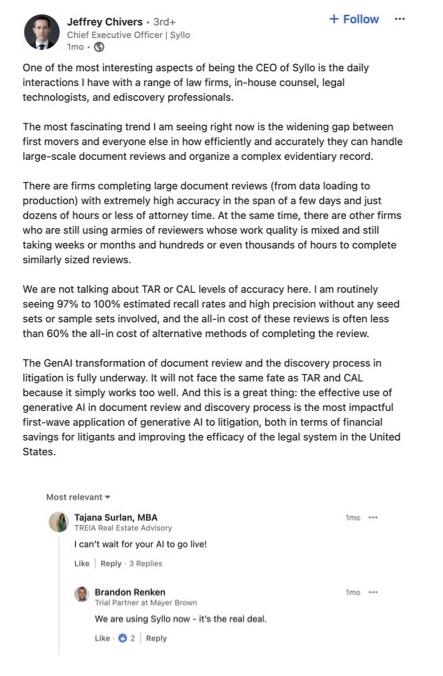
    One of the most interesting aspects of being the CEO of Syllo is the daily interactions I have with a range of law firms, in-house counsel, legal technologists, and ediscovery professionals.

    The most fascinating trend I am seeing right now is the widening gap between first movers and everyone else in how efficiently and accurately they can handle large-scale document reviews and organize a complex evidentiary record.

    There are firms completing large document reviews (from data loading to production) with extremely high accuracy in the span of a few days and just dozens of hours or less of attorney time. At the same time, there are other firms who are still using armies of reviewers whose work quality is mixed and still taking weeks or months and hundreds or even thousands of hours to complete similarly sized reviews.

    We are not talking about TAR or CAL levels of accuracy here. I am routinely seeing 97% to 100% estimated recall rates and high precision without any seed sets or sample sets involved, and the all-in cost of these reviews is often less than 60% the all-in cost of alternative methods of completing the review.

    The GenAI transformation of document review and the discovery process in litigation is fully underway. It will not face the same fate as TAR and CAL because it simply works too well. And this is a great thing: the effective use of generative AI in document review and discovery process is the most impactful first-wave application of generative AI to litigation, both in terms of financial savings for litigants and improving the efficacy of the legal system in the United States.

    As Syllo users say: its “the real deal.”

    A LinkedIn post from Syllo's CEO, Jeffrey Chivers. One of the most interesting aspects of being the CEO of Syllo is the daily interactions I have with a range of law firms, in-house counsel, legal technologists, and ediscovery professionals...
  • How AI is Reshaping Litigation, “Unlawful” Podcast Welcomes Jeff Chivers

    How AI is Reshaping Litigation, “Unlawful” Podcast Welcomes Jeff Chivers

    Syllo CEO and Co-Founder Jeffrey Chivers was featured recently in a three-part podcast series with Brandon Renken, a partner at Mayer Brown, a premier global law firm. Brandon is a highly accomplished trial lawyer with considerable courtroom experience, known for his work on complex commercial disputes in both state and federal courts. He has been recognized as a Super Lawyers “Rising Star” and also named to Houston Business Journal‘s “40 Under 40.” Jeff and Brandon engage in a substantive and candid discussion about Jeff’s unique career path, his motivations for founding Syllo, and how attorneys can mitigate risks typically associated with AI. 

    The first part of the series, AI Pioneer, explores the origins of Syllo, tracing Jeff’s path from his time in college to his unconventional journey through his early years in practice. Jeff recounts his experiences living in Taiwan, cutting his teeth as a litigator at a small litigation practice, and clerking for federal judges, where he and co-founder Theo Rostow first recognized the early signs of a technological shift.

    The second part of the series Greater Efficiency in Litigation is a Public Good, shifts to the core motivations behind Syllo’s mission, the growth we have made as a company, and the confirmation the market is ready for a unified platform that rethinks traditional workflows. The discussion turns to the “dis-alignment” often seen between the merit of a lawsuit and its outcome, which, in complex litigation, typically stems from one party’s ability to marshal more attorney time than its opponent. Building greater efficiency without sacrificing quality, then, would be a public good, leveling the playing field and making the merits of cases more determinative of litigation outcomes.  

    Finally, in part 3 Unlawful Podcast: The Things About Hallucinations, the discussion turns to the critical topic of AI and a commonly perceived challenge: hallucination.  Jeff explains that earlier versions of large language models generated outputs without reference to any legal database or source of truth.  However, large language models can be integrated into applications that include such databases.  This enables them to identify requests for factual information at the outset and query a database to provide a sourced response.  The series concludes with a shared vision for a future where AI empowers litigators to focus on strategy, a future that is not just theoretical but actively being built today.